
Table of Contents
Contents are generated from article headings.
A debt-inclusive budget is a financial plan that treats debt payments as a structural constraint — not a temporary inconvenience — and allocates income across three compartments: survival and minimums, debt acceleration and emergency protection, and sustainable living. Total U.S. household debt reached $18.04 trillion in Q4 2024, making debt payments one of the most common budget constraints affecting American households.
Debt fundamentally changes budgeting mathematics because debt payments reduce available income before discretionary allocation begins. A person earning $4,500/month with $650 in minimum debt payments has functionally $3,850 of allocable income — and the budget must be designed around this reduced capacity, not the gross income figure.
This content discusses budgeting with debt obligations using financial planning principles and consumer debt data. Debt products, interest rates, and repayment options vary by jurisdiction and creditor. FinQuarry provides informational content only — this does not constitute personalized financial advice.
The Three-Compartment Budget Model
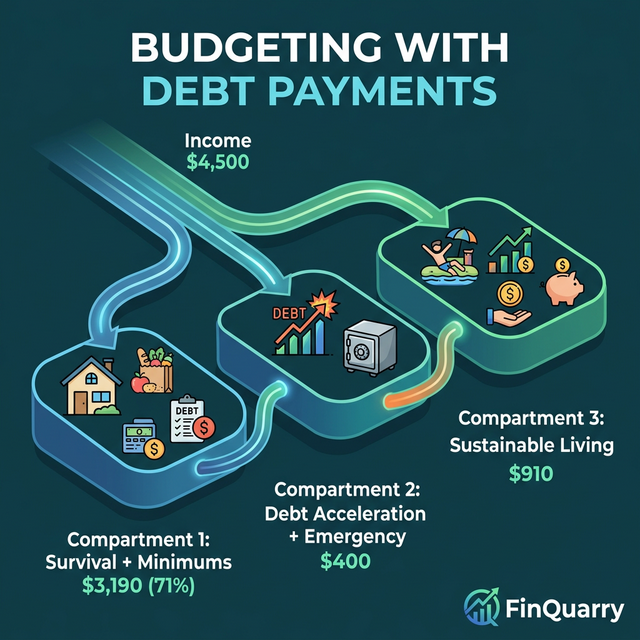
Compartment 1: Survival + Minimums
All non-negotiable costs including minimum debt payments:
- Housing: $1,400
- Utilities: $240
- Food (basic): $420
- Insurance: $280
- Transportation: $200
- Minimum debt payments: $650
- Total: $3,190 (71% of $4,500 income)
The survival + minimums compartment must be fully funded before any other allocation. A person whose Compartment 1 exceeds 80% of income is in a structurally constrained position where debt acceleration is limited.
Compartment 2: Debt Acceleration + Emergency Protection
After Compartment 1, direct a defined amount to above-minimum debt payments and emergency fund building — simultaneously.
Common advice says “pay off all debt before saving.” This advice fails the risk test: a person who directs every surplus dollar to debt and maintains $0 in savings will be forced back into debt at the first unexpected expense ($400 car repair, $300 medical bill). The debt payment is then partially undone.
Split approach: 70% to debt acceleration, 30% to emergency fund until a $500 starter emergency fund is established. Then shift to 100% debt acceleration until the target debt is eliminated.
A person allocating $400/month to Compartment 2: $280 to highest-interest debt, $120 to emergency fund. By month 5, the $500 emergency fund is funded. From month 6: $400/month to debt acceleration.
Compartment 3: Sustainable Living
Everything remaining after Compartments 1 and 2. On $4,500 income with $3,190 in Compartment 1 and $400 in Compartment 2: $910 remains for all variable spending, discretionary purchases, and quality-of-life spending.
The $910 is not generous — but it is funded after protection and progress, making it guilt-free spending.
Debt Payoff Strategy Selection
The Avalanche Method (Math-Optimal)
Pay minimums on all debts. Direct all extra payments to the highest-interest-rate debt first.
A person with:
- Credit card: $4,200 at 22% APR (min. $120)
- Car loan: $8,500 at 6% APR (min. $280)
- Student loan: $15,000 at 5% APR (min. $250)
Avalanche targets the 22% credit card. The $280/month in acceleration payments (from Compartment 2 after emergency fund is built) eliminates it in approximately 14 months, saving $800+ in interest compared to the snowball method.
The Snowball Method (Psychology-Optimal)
Pay minimums on all debts. Direct all extra payments to the smallest balance first.
Same debt portfolio: snowball targets the $4,200 credit card (also smallest, in this case the same target). When debts differ in size ordering, snowball provides earlier psychological wins — the first debt elimination reinforces the behavior.
Which Method?
If you need motivation — snowball. If you can sustain effort without psychological rewards — avalanche saves more money. Research indicates that completion of individual debts (regardless of size or interest rate) increases the probability of continued debt payoff behavior.
The Debt-to-Income Ratio Check
Total minimum monthly debt payments ÷ gross monthly income = debt-to-income ratio.
$650 minimums ÷ $4,500 gross = 14.4% DTI. Below 15% is generally manageable with accelerated payoff. Between 15–25% is strained but workable with budget compression. Above 25% may warrant professional financial counseling or debt restructuring.
The Consumer Financial Protection Bureau recommends that total debt payments (including housing) remain below 36% of gross income.
Should I Save or Pay Off Debt First?
Both — simultaneously, in the split approach described in Compartment 2. Pure debt focus with $0 savings creates vulnerability that will likely generate new debt. Pure savings focus while carrying 22% APR debt loses money mathematically (savings earns 4–5%, debt costs 22%).
The split approach provides protection while maintaining mathematical efficiency.
When Is Professional Help Needed?
When minimum payments exceed 25% of gross income, when payments are being missed, or when multiple creditors have been contacted for hardship without resolution — nonprofit credit counseling through an NFCC member agency provides structured debt management programs that consolidate payments and often reduce interest rates.
Written by Sarah Mitchell, Financial Content Strategist | Reviewed by Riley Thompson, Editor & Compliance Reviewer, FinQuarry