
Table of Contents
Contents are generated from article headings.
A sustainable budget is a financial plan built from actual spending data, matched to the person’s cognitive style, and designed for 80% compliance rather than perfection. Budget sustainability — not budget creation — is the primary challenge: most financial plans fail not because they are poorly calculated but because they are psychologically incompatible with the person who must execute them.
The most effective budget is not the most detailed one. It is the one the person actually follows for 12 consecutive months. A simple three-category budget maintained for a year outperforms a sophisticated 20-category system abandoned after six weeks.
This content discusses sustainable budgeting approaches using behavioral economics and financial planning principles. Individual circumstances, income patterns, and behavioral styles vary. FinQuarry provides informational content only — this does not constitute personalized financial advice.
Step 1: Start From Actual Data, Not Goals
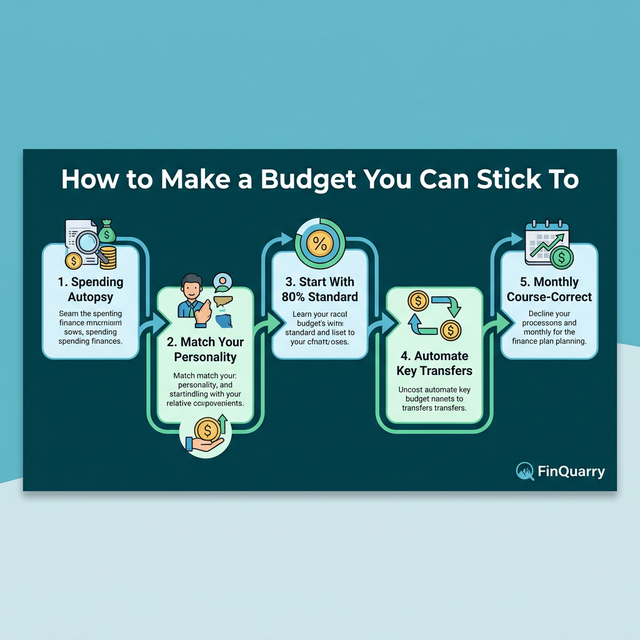
The Spending Autopsy
Pull 3 months of bank and credit card statements. Categorize every transaction into 5–7 groups. Calculate monthly averages.
The person who thinks they spend $300/month dining out but discovers a $460 average has found the first reason every previous budget failed: the starting point was fiction. A budget built from actual spending data starts from truth — and adjustments from truth are sustainable in a way that adjustments from fiction are not.
What the Autopsy Reveals
Common discoveries: grocery spending 20–30% higher than estimated, subscription costs accumulating to $60–120/month across services rarely used, and “miscellaneous” spending (convenience purchases, impulse buys) absorbing $150–300/month that was invisible in estimates.
Step 2: Match Complexity to Personality
The Tracking Tolerance Test
Ask honestly: “Can I log every transaction for 30 days?” If yes — detailed methods like zero-based budgeting may work. If no — simplified approaches like the 50/30/20 rule or anti-budget methods are more sustainable.
The method must match cognitive style:
- Detail-oriented: Zero-based or envelope system
- Big-picture: 50/30/20, reverse budget
- Technology-resistant: Paper envelopes, manual methods
- Variable income: Priority waterfall
The Minimum Viable Budget
If in doubt, start with the simplest approach: auto-save on payday, auto-pay bills, spend the rest. If this produces adequate savings, complexity is unnecessary. Only add structure when the simple approach reveals a specific problem (overspending in one category, insufficient debt reduction, missed savings targets).
Step 3: Include Guilt-Free Spending
A budget without a discretionary allocation is a budget designed to fail. The person must be able to spend some money without justification, categorization, or guilt.
A person earning $4,500/month might allocate $150/month as “personal money” — no tracking, no categories, no reporting. This $150 prevents the deprivation that causes $400 in compensatory spending when the psychological dam breaks.
Step 4: Plan for Imperfection
The 80% Standard
A budget hitting 80% of its targets across 80% of months is high-performing. The person who maintains 80% compliance for 12 months produces dramatically better outcomes than the person achieving 100% for 6 weeks and then abandoning.
Specific deviations are data, not failure: “I overspent dining by $80 three months in a row” means the dining allocation needs increasing — not that the person lacks discipline.
Monthly 15-Minute Calibration
One monthly review replaces daily tracking: compare actual category spending to plan, note 2–3 adjustments, update next month’s targets. The review uses bank statement data, not memory, and takes 15 minutes.
Step 5: Automate Everything Possible
Every automated action is one fewer opportunity for failure:
- Auto-transfer savings on payday
- Auto-pay all recurring bills
- Auto-transfer sinking fund contributions
- Auto-pay minimum debt payments
After automation, the budget functions correctly even during weeks when the person cannot or does not engage with it.
What If the Budget Works But I Still Feel Stressed?
Budget stress that persists despite adequate savings and manageable spending typically reflects financial anxiety rather than budget design. The intervention is anxiety management, not budget adjustment.
How Long Before a Budget Feels Natural?
Behavioral research on habit formation suggests 60–90 days for a new behavior to become automatic. Months 1–2 feel effortful. Month 3 feels routine. By month 4, the budget is a background system rather than a daily project.
Written by Sarah Mitchell, Financial Content Strategist | Reviewed by Riley Thompson, Editor & Compliance Reviewer, FinQuarry