
Table of Contents
Contents are generated from article headings.
Expense tracking difficulty is a behavioral resistance pattern caused by effort-reward imbalance, emotional aversion, decision fatigue, and delayed feedback loops — not laziness or financial irresponsibility. Understanding why expense tracking triggers resistance is the prerequisite to building a tracking approach that can be sustained beyond the typical 14-day engagement cliff.
Budgeting apps report that user engagement drops 40–60% between week one and week three. This pattern repeats across every tracking platform and demographic — indicating a universal psychological barrier rather than a platform problem or a personal failing.
This content discusses expense tracking psychology using behavioral economics, habit formation research, and financial planning principles. Individual tracking tolerance varies by cognitive style and financial situation. FinQuarry provides informational content only — this does not constitute personalized financial advice.
The Four Psychological Barriers
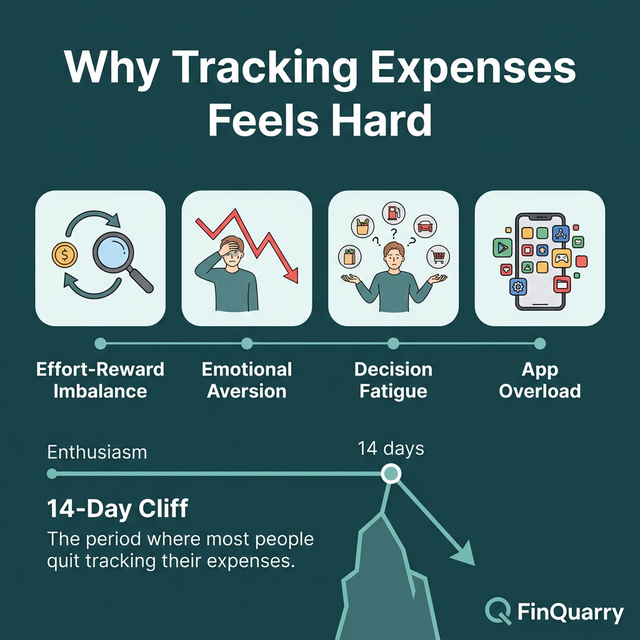
Barrier 1: Effort-Reward Imbalance
Expense tracking requires daily cognitive effort: recording transactions, categorizing purchases, reconciling totals. The effort is immediate and concrete. The reward — financial awareness — peaks during days 1–10 (when spending patterns are first discovered) and then plateaus. By week two, the same effort produces diminishing informational return because patterns are already known.
When ongoing effort exceeds perceived benefit, behavior abandonment follows. This is not a willpower failure — it is a rational cost-benefit response.
Barrier 2: Emotional Aversion
Every tracked transaction forces confrontation with spending behavior. A $7 lunch logged as “dining – unnecessary” triggers micro-guilt. Multiplied across 8–12 daily transactions, the cumulative emotional load transforms tracking from a neutral data exercise into a judgment process — each entry asking “should I have spent this?”
For people with financial anxiety, tracking amplifies the anxiety rather than reducing it. The awareness that tracking provides comes packaged with the emotional weight of seeing every decision quantified and categorized.
Barrier 3: Decision Fatigue
Categorizing each purchase requires a micro-decision: “Is this $4.50 charge groceries, dining, or household supplies?” These categorization decisions — trivial individually — accumulate across a day’s transactions and deplete the same cognitive resources needed for actual financial decision-making.
A person making 15–20 categorization decisions daily has consumed meaningful decision capacity on administrative overhead rather than strategic financial choices.
Barrier 4: Delayed Feedback
Expense tracking provides retrospective information: where money went. The actionable benefit — adjusting future spending — happens days or weeks later. The brain’s reward system is poorly equipped to value delayed outcomes, making the tracking effort feel unrewarded in real-time even when it produces long-term financial improvement.
Five Strategies for Sustainable Tracking
Strategy 1: Reduce Categories to 3–5
Replace 15-category granular tracking with 3–5 broad categories: fixed obligations, food/household, transportation, discretionary, savings. Fewer categories mean fewer categorization decisions and faster processing.
Strategy 2: Weekly Batch Processing
Replace daily transaction logging with once-weekly review. Spend 10 minutes reviewing the week’s bank statement, noting category totals and any surprises. This reduces tracking from a daily obligation to a weekly habit — requiring 10 minutes instead of 10+ minutes daily.
Strategy 3: Use the Balance Method
Instead of tracking individual transactions, monitor the spending account balance at regular intervals. Starting balance of $1,500 on day 1. Balance of $750 on day 15 = on track. Balance of $500 on day 15 = spending too fast. One number provides directional awareness without transaction-level tracking.
Strategy 4: Automate Where Possible
Bank apps automatically categorize transactions. Linking accounts to a tracking tool eliminates manual data entry — the highest-effort component. If automation handles 80% of tracking, the person handles only exceptions and review.
Strategy 5: Track Only What Matters
If dining spending is the category most likely to overshoot, track only dining for the first month. Targeted tracking produces actionable insight with minimal effort — and the success of controlling one category builds confidence for expanding tracking later.
When Tracking Is Not the Right Tool
For some people, tracking will never be sustainable — and that is acceptable. The alternative: automate savings on payday, auto-pay bills, and manage remaining spending through the balance method. This approach provides less granular data but is sustainable indefinitely, producing better long-term outcomes than granular tracking that is abandoned after two weeks.
Is Expense Tracking Necessary?
Expense tracking is necessary during the discovery phase (months 1–3 of any new budget), when spending patterns are unknown. After patterns are established, tracking can be reduced to weekly balance monitoring and monthly category review. The transition from daily tracking to periodic monitoring maintains awareness without the cognitive burden that causes abandonment.
What If I Cannot Make Myself Track at All?
If tracking triggers avoidance despite trying multiple methods, the resistance may stem from financial anxiety rather than tracking difficulty. The intervention is addressing the anxiety — potentially through financial therapy — rather than finding a better tracking app.
Written by Sarah Mitchell, Financial Content Strategist | Reviewed by Riley Thompson, Editor & Compliance Reviewer, FinQuarry