Table of Contents
Contents are generated from article headings.
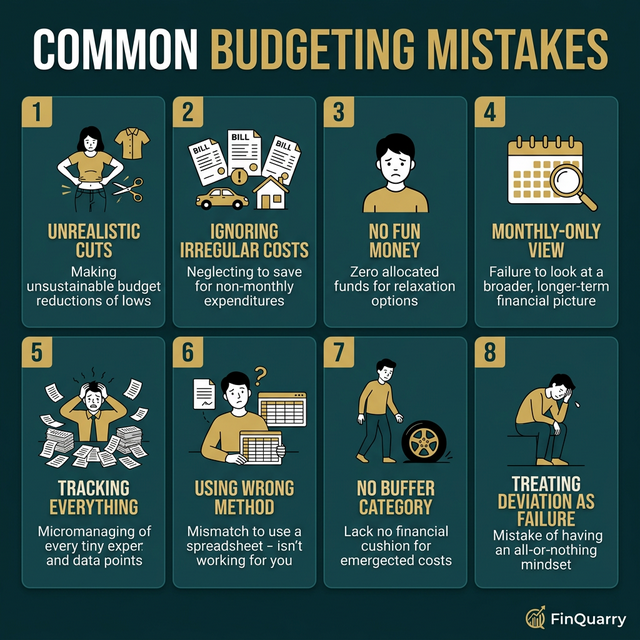
Budgeting mistakes are systematic design errors — not spending failures — that cause budgets to produce inaccurate projections, unsustainable restrictions, or tracking fatigue that leads to abandonment. Research on financial behavior indicates that budget abandonment rates exceed 60% within 90 days, with the same 8 mistakes appearing across income levels and demographics.
Identifying these mistakes before they compound is the difference between a budget that calibrates over time and a budget that fails within weeks.
This content discusses common budgeting errors using behavioral economics, consumer finance data, and financial planning frameworks. Financial products and economic conditions vary by jurisdiction. FinQuarry provides informational content only — this does not constitute personalized financial advice.
Mistake 1: Building From Estimates Instead of Data
The most damaging budgeting mistake is constructing category allocations from what a person thinks they spend rather than what they actually spend. Estimation bias consistently understates spending in high-frequency, low-amount categories (coffee, delivery fees, convenience items) and overstates the ability to cut socially embedded spending (dining, gifts, entertainment).
A person estimating $200/month for dining who pulls three months of statements and discovers a $380 average has identified a $180/month design error. Across 4–5 similarly underestimated categories, the accumulated gap can exceed $400/month — explaining why the budget “never works” despite appearing balanced on paper.
Fix: Build every budget from 3 months of actual bank/credit card data.
Mistake 2: Setting Savings First, Living on the Rest
Many budgets set an ambitious savings target ($500/month) and then allocate the remainder to living expenses — discovering that the remainder is inadequate for actual needs. This approach reverses the sustainable sequence.
Fix: Calculate survival floor first (actual essential expenses), then set savings at a sustainable level (5–10% initially), then allocate remaining to discretionary. The person saving $200/month consistently for 12 months ($2,400) outperforms the person saving $500/month for 3 months ($1,500) and quitting.
Mistake 3: Ignoring Irregular Expenses
Annual insurance ($600–1,200), car maintenance ($700–1,200), holiday gifts ($500–1,500), medical co-pays ($200–800), home repairs ($300–1,000). These predictable-but-not-monthly costs total $2,300–5,700/year — arriving as “surprises” that break budgets mid-month.
Fix: Total last year’s non-monthly expenses. Divide by 12. Auto-transfer this amount monthly to a sinking fund.
Mistake 4: Over-Reliance on Willpower
A budget requiring daily willpower expenditure — resisting purchases, manually logging transactions, constantly monitoring categories — depletes cognitive resources through ego depletion. This produces the “works for two weeks then collapses” pattern.
Fix: Automate the critical behaviors (savings transfer, bill payment, sinking fund contribution) so the budget functions correctly even during weeks when the person lacks energy to engage. The budget should require willpower for exceptions, not for normal operation.
Mistake 5: Too Many Categories
A budget with 15–20 spending categories creates tracking overhead that produces decision fatigue and categorization paralysis (“Does Netflix count as entertainment or subscriptions?”). More categories do not produce more control — they produce more cognitive load.
Fix: Consolidate to 5–7 categories maximum. Each should be broad enough to absorb sub-category variation: “Food” rather than “Groceries, Restaurants, Coffee, Snacks.”
Mistake 6: No Discretionary Allocation
A budget that eliminates all “unnecessary” spending creates the deprivation trap — restriction produces compensatory binge spending that costs more than a planned discretionary allocation would have.
Fix: Budget $75–150/month (depending on income) as explicitly funded guilt-free spending. This allocation prevents the psychological pressure that causes budget rebellion.
Mistake 7: One-Time Budget Creation
Creating a budget in January and expecting it to function through December without adjustment is designing for a reality that does not exist. Income changes, prices shift, priorities evolve, and seasonal patterns alter spending.
Fix: Monthly 15-minute review comparing actual spending to plan, with 2–3 category adjustments. Quarterly recalibration of rolling averages and sinking fund targets.
Mistake 8: Treating Deviations as Failure
A single overspent category or one “bad” month should not trigger budget abandonment. All-or-nothing thinking converts minor variance into system failure.
Fix: The 80% standard — a budget hitting 80% of targets across 80% of months is performing well. Deviations produce calibration data, not evidence of personal failure.
How Many Mistakes Does the Average Budget Contain?
Most failed budgets contain 3–5 of these 8 mistakes simultaneously. The combination produces cascading failure that feels like “budgets don’t work for me” when the actual problem is specific, identifiable, and fixable design errors.
Written by Marcus Tremblay, Senior Financial Analyst | Reviewed by Riley Thompson, Editor & Compliance Reviewer, FinQuarry