Table of Contents
Contents are generated from article headings.
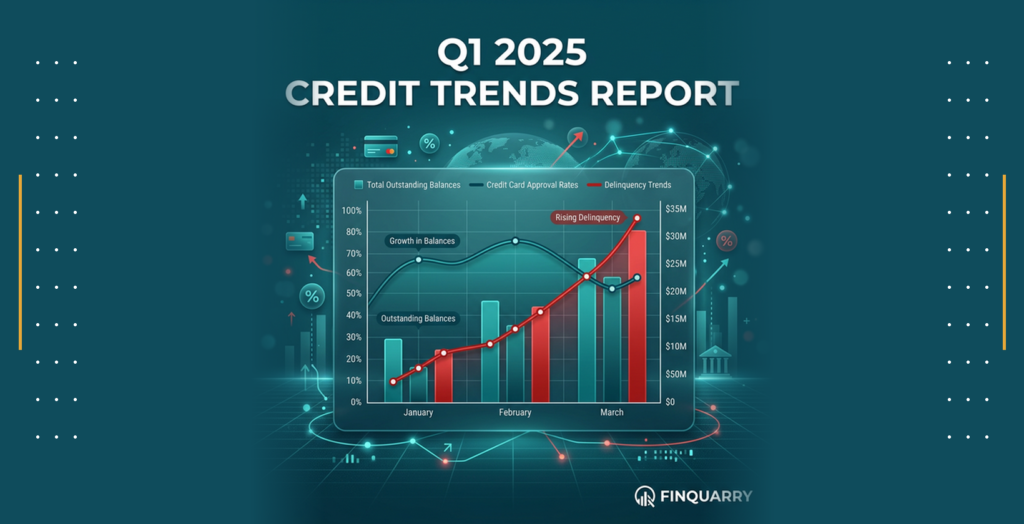
Q1 2025 marks a period of uneven credit performance across U.S. households.
Total household debt reached $18.20 trillion, driven primarily by mortgage balances. Nonrevolving and revolving credit expanded but at the slowest pace in several years. Prime borrowers remained financially stable, while subprime and younger households showed rising repayment stress.
The sharpest adjustment occurred in student loans, where delinquencies rose significantly following the end of federal forbearance provisions. Auto loan performance weakened further due to affordability challenges and persistently high interest costs. Credit card balances continued to grow, though at a slower pace, with younger borrowers showing the fastest deterioration in repayment behavior.
Overall, Q1 2025 reflects a combination of elevated household leverage, tighter lending standards, and uneven consumer resilience.
1. Household Debt Overview
1.1 Aggregate Balances

As of March 31, 2025:
| Debt Type | Balance (USD Trillions) |
| Mortgage | $12.804T |
| Home Equity Revolving | $0.402T |
| Auto Loans | $1.642T |
| Credit Cards | $1.182T |
| Student Loans | $1.631T |
| Other Debt | $0.542T |
| Total Household Debt | $18.203T |
Quarter-over-quarter growth: +0.9%
Source: Household Debt & Credit Data: Federal Reserve Bank of New York (HHD&C Release Center)
Mortgage balances remained the primary driver of overall debt, while non-mortgage categories continued to reflect elevated borrowing costs.
2. Delinquencies & Financial Stress
Delinquency rates increased across multiple products, reaching the highest levels observed since before the pandemic. Stress was concentrated in student loans, auto loans, and younger consumer segments rather than being broad-based.
2.1 Serious Delinquencies (Q1 2025)

| Debt Type | Serious Delinquency Rate |
| Student Loans | 7.7% (90+ DPD) |
| Credit Cards | 2.43% (90+ DPD) |
| Auto Loans | 1.38% (60+ DPD) |
| Mortgage | 1.44% (60+ DPD) |
| Personal Loans | 3.49% |
| Aggregate | 4.3% |
Source: Federal Reserve Bank of New York (HHD&C Q1 2025); TransUnion Credit Industry Insights Report (Q1 2025)
Student loan delinquency saw the most significant shift due to the return of full reporting requirements. Auto loan delinquency reached its highest rate since Q1 2009, while credit card performance deteriorated first among younger borrowers.
3. Originations & New Credit Activity
3.1 Mortgage Originations
Mortgage originations increased significantly, supported by refinancing activity triggered by shifts in interest-rate expectations. YoY growth for originations in late 2024 (reported in Q1 2025) reached +30.2%.
3.2 Auto Loan Originations
Auto loan originations increased +8% YoY, with new vehicles accounting for a larger share of financing. Higher interest rates and affordability challenges remained prominent constraints.
3.3 Credit Card Originations
Credit card originations recorded their first YoY increase in six quarters (+0.1%). Subprime originations rose, but average credit-line extensions were smaller.
3.4 Lending Standards
Lenders continued caution across most consumer credit categories. Risk-based segmentation increased, and personal loan lenders concentrated on super-prime borrowers.
4. Borrower Segmentation & Financial Resilience
4.1 Prime Borrowers
- Stable credit performance
- Lower delinquency rates
- Continued access to favorable terms
- Ability to refinance or consolidate debt
4.2 Subprime & Younger Borrowers
- Higher sensitivity to interest-rate changes
- Rising early-stage delinquencies
- Increased utilization of revolving credit
- More exposure to inflation-driven expenses
4.3 Income-Level Dynamics
Lower-income households experienced:
- Reduced liquidity
- Higher revolving balances
- Declining ability to absorb price pressures
5. Product-Specific Trends
5.1 Mortgage Debt
Mortgage balances reached $12.804T, with delinquencies increasing moderately for the twelfth consecutive quarter. Refinance activity improved as rate conditions became more favorable.
5.2 Credit Cards
Credit card balances remained historically high at $1.182T. Serious delinquencies improved YoY, but early-stage delinquencies rose among younger age groups, reflecting short-term cash-flow strain.
5.3 Auto Loans
Auto loan balances reached $1.642T. Growth slowed to 0.26% YoY (G.19), reflecting restrictive lending standards and affordability issues. Delinquency rates continued to rise.
5.4 Student Loans
Delinquency rates surged to 7.7%, marking the sharpest post-forbearance adjustment. Borrowers faced a rising repayment burden as protections expired.
5.5 Personal Loans
Delinquency rates declined slightly as lenders shifted originations toward super-prime profiles, narrowing risk exposure.
6. Accounts & Utilization Metrics
6.1 Active Accounts (Q1 2025)

| Loan Type | Accounts (Millions) |
| Credit Cards | 631.39M |
| Auto Loans | 108.11M |
| Mortgages | 85.78M |
| Home Equity Revolving | 13.14M |
Sourcing: Federal Reserve — G.19 Consumer Credit, March 2025 (Q1 Update)
Revolving credit products continued to anchor consumer borrowing behavior. Utilization indicators suggest households are managing recurring expenses via credit rather than periodic borrowing.
7. Insights from Federal Reserve G.19 Consumer Credit Statistics

7.1 Total Consumer Credit
Total consumer credit reached $5.01T, increasing 1.53% SAAR quarter-over-quarter and 1.93% YoY. Both measures reflect a slowdown relative to previous periods.
7.2 Nonrevolving Credit
Nonrevolving credit reached $3.68T, with 1.23% SAAR quarterly growth and 1.56% YoY expansion. Student loans and auto loan categories remain the dominant drivers.
7.3 Student Loans
Student loans totaled $1.80T, rising 2.48% YoY. Growth remains below pre-pandemic levels despite the upward trend over the past three quarters.
7.4 Auto Loans
Auto balances reached $1.56T, but YoY growth slowed to the weakest pace since 2010. Average new-car loan APR stood at 8.04%.
7.5 Revolving Credit
Revolving balances increased to $1.32T, reflecting 2.36% SAAR quarterly growth and 2.98% YoY. Despite elevated interest rates, recent months showed modest easing in credit card APRs.
Sourcing: Aryza Insolvency Dataset, Q1 2025
8. Insolvency & Corporate Credit Conditions
Corporate insolvencies increased compared with early 2024. Lenders reported tighter credit conditions for commercial borrowers. Businesses with lower credit ratings continued to face higher refinancing costs and limited access to new capital.
9. Economic & Policy Context
- Inflation moderated but continued to exceed target levels.
- Tariff policy changes were expected to introduce upward price pressure later in 2025.
- Consumer confidence weakened.
- Labor-market sentiment softened as hiring slowed.
- Real debt growth remained modest when adjusted for inflation.
10. Outlook for 2025
Current indicators suggest:
- Mortgage activity is likely to continue stabilizing if interest-rate volatility declines.
- Student loan delinquencies will remain elevated through the year.
- Auto loan stress is expected to persist due to high vehicle prices and tight lending standards.
- Credit card stress will continue rising among younger borrowers.
- Personal loan performance is projected to remain stable, supported by conservative origination strategies.
11. Scenario Modelling – What Could Happen 2025‑2026
| Scenario | Trigger Conditions | Possible Outcome & Risk | Stakeholder Implication |
| Baseline / Moderate Stress | Interest rates remain elevated or decline slowly; wage growth stays modest; inflation stabilizes | Mortgage debt remains relatively stable. However, unsecured debt (student loans, credit cards, auto) becomes a growing source of defaults. Delinquency rates edge up gradually. | Credit‑risk divisions in banks and lenders recalibrate stress tests; demand for advisory, debt‑management, and consolidation services increases. |
| Economic Downturn / Income Shock | Labor‑market softening; inflation or cost‑of‑living spikes; real incomes shrink for lower/middle income households | Significant rise in delinquency and defaults across unsecured and high‑cost credit. Increased use of home‑equity (HELOC) withdrawals. Higher bankruptcy filings and collections. | Higher loss‑provisions for lenders; tighter underwriting; real estate and consumer‑credit markets see pressure; investors re‑price risk in consumer credit portfolios; media and regulators flag consumer distress. |
| Refinancing‑Relief + Recovery | Interest rates moderate; refinancing becomes viable; incomes recover; inflation eases | Households with mortgages refinance, reducing monthly debt‑service burden. Delinquency rates on unsecured products stabilize or improve modestly. Consumer sentiment recovers; credit demand rebounds. | Housing market stabilizes; refinancing boom; renewed credit demand — but lenders remain cautious on subprime/unsecured segments. |
| Polarised / “K‑shaped” Stress | Economic recovery benefits higher‑income borrowers; lower‑income, subprime, younger borrowers remain under cost/income pressure | Divergence in credit health: prime/high‑income households remain stable or improve; vulnerable borrowers see rising defaults. Aggregate debt remains high but masked by stable mortgage‑heavy portfolios. | Lenders face concentrated risk in subprime/unsecured portfolios; inequality in credit access/quality deepens; policymakers and regulators may intervene; social and economic disparity becomes more visible. |
Disclaimer : this scenario are my assumption that i made based o this all report and my analysis.
12. Expert Interpretation & Strategic Analysis
Mortgage‑heavy aggregate debt hides underlying fragility.
While nearly half (or more) of total household debt is anchored in long‑term mortgage obligations — which typically have lower delinquency rates — this creates a misleading view of stability. Growth in unsecured debt and rising delinquency in categories such as student loans, credit cards, and auto loans signal pressure building beneath the surface. For lenders or investors focusing only on aggregate debt, this can understate real credit‑risk exposure.
Debt composition and borrower profile matter more than headline totals.
A portfolio dominated by mortgages (especially those backed by equity or low loan‑to‑value ratios) behaves differently under stress than one loaded with unsecured or high‑cost credit. The latter is far more vulnerable to interest‑rate spikes, income compression, or cost‑of‑living shocks. As data suggests, stress is increasingly concentrated among younger, subprime, or lower‑income borrowers — segments with less buffer to absorb shocks.
Refinancing cycles and interest‑rate shifts are critical stress levers.
A moderate decline in interest rates could relieve many mortgage holders and reduce overall debt‑service burdens, easing pressure on housing‑related credit. However, such relief does little for unsecured debt holders. Hence, refinancing‑driven relief could improve credit health overall — but only for a subset of borrowers. The rest remain exposed.
Credit‑market segmentation and inequality are increasing systemic risk.
The divergence between stable prime borrowers and stressed subprime/younger households may lead to a bifurcated credit system: one resilient, another fragile. That segmentation hides systemic risk: defaults may cluster among the vulnerable, provoking localized stress in particular credit‑product markets, or clusters of consumer distress under adverse macro conditions.
For banks, investors and consultants — risk concentration now demands nuanced strategy.
Relying on broad averages or thick mortgage portfolios may give false comfort. Portfolios heavy in unsecured or subprime credit require robust provisioning, dynamic risk assessment, and stress‑testing under multiple macro scenarios. Advisory and consulting services offering debt‑management, consolidation strategies, or early intervention may see higher demand. Policymakers and regulators may need to monitor concentration risk, credit inequality, and systemic implications.
13. Unique Value Proposition: Why This Report Matters
- Combines publicly available data (through the New York Fed’s Household Debt and Credit releases) with forward‑looking scenario modelling to deliver not just a snapshot, but a structured forecast.
- Focuses on debt composition and borrower heterogeneity, rather than just aggregate debt — enabling targeted risk assessment and policymaker insight.
- Embeds macroeconomic context and identifies key levers (interest rates, income, underwriting standards) that will shape consumer credit health — making the report useful not just to credit‑industry stakeholders, but macro analysts, policymakers, and investor‑risk teams.
- Provides a framework for stress testing portfolios under different economic scenarios — valuable for financial institutions, consultants, and analysts who evaluate credit‑risk exposure.
Primary Public Data Sources:
- Federal Reserve Bank of New York (Household Debt & Credit),
- Federal Reserve G.19 Consumer Credit,
- TransUnion Credit Industry Insights Report (CIIR),
- Equifax Consumer Credit Trends,
- Experian Lending Conditions Chartbook,
- EyeOnHousing Consumer Credit Summary,
- Western Asset Consumer Conditions,
- Aryza Insolvency Insights.
Purpose:
To present a clear, data-anchored assessment of U.S. consumer credit conditions during Q1 2025, including balances, originations, delinquencies, and household financial stress indicators.
scenario modelling, or expert interpretation. Without that, the report risks being “just another summary,” which limits its attractiveness to high‑authority publishers, investors, or high‑end consultants.