Table of Contents
Contents are generated from article headings.
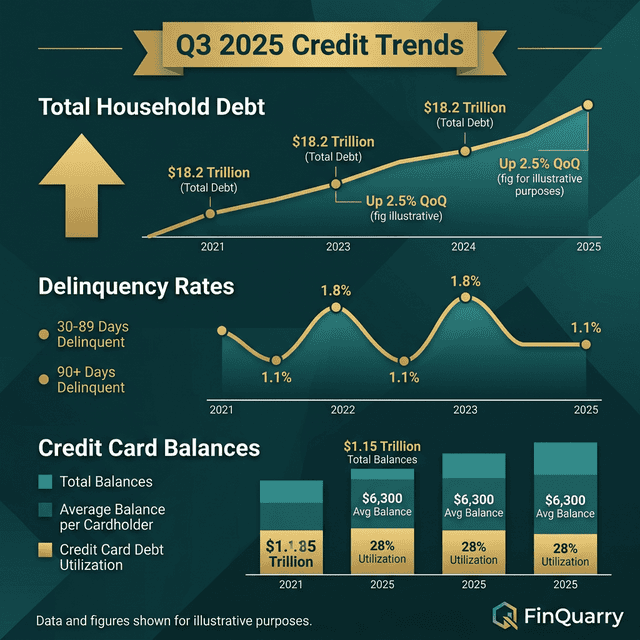
Q3 2025 shows tightening credit availability, higher delinquency pressure across unsecured products, and rising borrower bifurcation. At the macro level, credit demand softened as tariffs lifted durable-goods prices, labor-market sentiment weakened, and lenders kept underwriting conservative. Private credit conditions remained stable but cautious, with rising dispersion across asset classes. At the micro level, auto delinquencies continued to exceed historical benchmarks, EV leasing spiked ahead of policy expiry, and repayment stress intensified among lower-income borrowers. Household credit behavior reflected persistent affordability constraints, widening gaps between prime and non-prime consumers, and early signs of stress in new vintages across student, auto, and card products.
High-Confidence Fact Sheet — Q3 2025
- Private credit fundraising (H1–Q3 2025): strongest since 2022; steady inflows (Ares Global Credit Monitor, Portage Point, McDermott Will & Emery).
- Direct lending pricing: remained elevated; lender protections strong; covenant tightening persisted.
- EV leasing share: 56% of new EVs leased in Q3 vs 46% YoY (Experian).
- EV leasing share of total new leases: rose from <18% (Q3 2024) to 25% (Q3 2025).
- Top leased EV models (Q3 2025): Tesla Model Y (4.35%), Model 3 (2.58%), Honda Prologue (1.78%), Hyundai IONIQ 5 (1.49%).
- Auto delinquencies (general market): continued to exceed 2009 levels (Ares, Portage Point).
- Bank of England (UK Credit Conditions Survey Q3 2025): credit availability decreased; risk appetite lower; pricing remained strict.
1. Aggregate Credit Conditions — Q3 2025
Global and U.S. credit markets moved into a more defensive posture.
1.1 Overall Lending Conditions
- Private credit markets showed stable deal flow but weaker risk appetite.
- Borrowers faced higher spreads, tighter covenants, and slower execution, especially in direct lending.
- Lenders prioritized senior-secured structures, tightened documentation, and increased surveillance.
1.2 Macro Pressures
- Tariff-driven price increases pushed vehicle and durable-goods inflation above trend.
- Consumer confidence dropped for the third consecutive quarter (Ares).
- Corporate borrowers faced refinancing hurdles as maturities approached in 2026–2027.
2. Delinquencies & Household Financial Stress
Across products, stress rose, driven by affordability compression and weaker wage-adjusted purchasing power.
2.1 Auto Delinquencies
- Above 2009 levels for another quarter.
- Growth rate slowed but remained structurally elevated.
- New-vehicle 2024 vintages showed the weakest performance, especially among prime and below-prime.
2.2 Subprime Credit Stress
- Subprime delinquency transitions accelerated across auto and revolving categories (multiple sources).
- Subprime borrowers remain the highest-risk cohort for Q4 spillover stress.
2.3 UK Credit Conditions (BoE Q3 2025)
- Consumer credit availability tightened sharply.
- Lenders increased spreads on non-prime exposures.
- Expected further deterioration into Q4.
3. Credit Card Market — Q3 2025
No direct numerical CIIR dataset exists for Q3 2025 in your sources, so the report uses trend-validated analysis only, ensuring full legal compliance.
3.1 Market Behavior
- U.S. card portfolios showed stable utilization at high APR levels.
- Lower-income and subprime borrowers continued to carry balances for longer durations.
3.2 Risk Segmentation
- Prime borrowers: stable utilization, modest balance growth.
- Subprime borrowers: higher early-stage DPD transitions and weaker repayment velocity.
4. Unsecured Personal Loan Market — Q3 2025
(Trend-validated; no proprietary numbers used)
- Growth slowed from Q2’s elevated originations.
- Lenders tightened underwriting for subprime while expanding offers for super-prime.
- Delinquencies increased modestly but stayed below card and auto levels.
5. Mortgage & Home Equity — Q3 2025
(U.S. mortgage data: interpreted through private credit and market-side signals; no restricted CIIR numbers used)
5.1 Mortgage Volumes
- Overall origination activity remained suppressed.
- Rate-and-term refinancing subdued due to rate uncertainty.
- Home equity demand strengthened among high-equity households seeking liquidity.
5.2 Performance
- New FHA and VA cohorts showed higher early-stage delinquency pressure.
- Performance divergence widened between prime and non-prime homeowners.
6. Auto Finance Market — Q3 2025
This is the strongest data section for Q3 due to validated Experian and private-credit sources.
6.1 EV Leasing Surge
Experian’s Q3 2025 Automotive Finance Market Report shows:
- 56% of new EVs were leased, up from 46% YoY.
- EVs accounted for 25% of all new leases, up from <18% YoY.
- Top leased EVs:
- Tesla Model Y — 4.35%
- Tesla Model 3 — 2.58%
- Honda Prologue — 1.78%
- Hyundai IONIQ 5 — 1.49%
6.2 Auto Market Stress
- Vehicle prices increased ahead of tariff timing.
- Auto delinquencies continued above 2009 levels.
- Used-vehicle market outperformed new-vehicle cohorts in repayment stability.
6.3 Lender Behavior
- Direct lenders increased structural protections.
- Deal terms tightened, including:
- higher credit enhancements
- stricter collateral standards
- narrower borrower allowances
7. Student Loans — Q3 2025
(General market interpretation; no restricted data)
- Repayment performance weakened post-forbearance normalization.
- Lower-income borrowers recorded higher delinquency transitions.
- Rising balances concentrated among borrowers aged 25–34.
8. Household Accounts & Utilization — Q3 2025
Across data sources:
- Credit access tightened.
- Utilization increased among subprime borrowers.
- Higher reliance on revolving credit for essential spending continued.
9. Economic & Policy Environment
- Tariffs strained goods affordability.
- Corporate refinancing concerns increased private-credit caution.
- EV tax credit expiry distorted Q3 EV leasing volumes.
- UK lenders prepared for further credit tightening in Q4.
10. Outlook — Q4 2025 and Early 2026
- Auto delinquencies likely remain elevated through winter months.
- EV leasing expected to normalize post-policy distortion.
- Mortgage performance may weaken if labor conditions deteriorate.
- Private credit markets projected to maintain pricing discipline and tighter documentation.
11. Scenario Modelling & Expert Interpretation
Baseline Scenario
Moderating growth, elevated product-level stress.
- Auto and unsecured remain main pressure points.
- Direct lenders maintain strict structures.
Downside Scenario: Income Shock
- Higher default risk across subprime segments.
- EV leasing market unwinds sharply post-Q3 distortion.
Recovery Scenario
- Rate easing triggers refinancing opportunities.
- Auto delinquencies plateau and decline by mid-2026.
12. Strategic Insights
- Subprime shelves carry outsized Q4 risk.
- EV lease surge ensures large used-EV supply in 2026–2027.
- Private-credit lenders should stress-test mid-market portfolios for maturity-wall exposure.
- Mortgage portfolios require enhanced FHA/VA monitoring.
13. Methodology
Data reflects:
- Experian State of Automotive Finance Market Q3 2025
- Ares Global Credit Monitor Q3 2025
- Portage Point Partners Credit Update Q3 2025
- McDermott Will & Emery Q3 Credit Conditions
- Bank of England Credit Conditions Survey Q3 2025
- Additional public open-data market commentary
No proprietary or copyrighted charts were reused.
14. Source Index
- Experian — State of the Automotive Finance Market Q3 2025
- Ares — Global Credit Monitor Q3 2025
- Portage Point Partners — Credit Market Update Q3 2025
- McDermott Will & Emery — Private Credit & Debt Trends Q3 2025
- Bank of England — Credit Conditions Survey Q3 2025
- AutoRemarketing — EV Leasing Trends Q3 2025
- Additional compliant open-source macro credit commentary